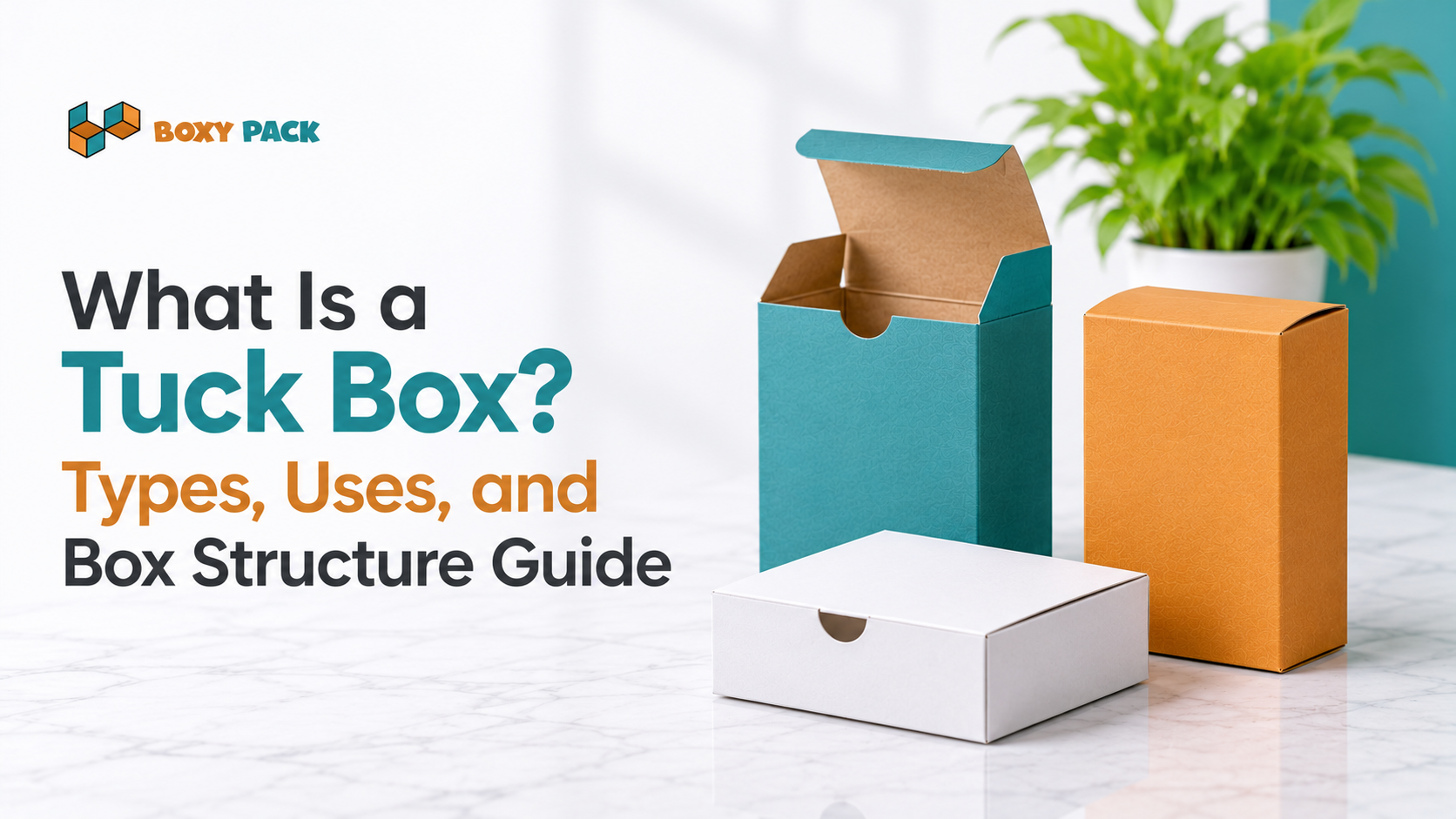
What is a tuck box? It is a folding carton with one or more flaps that fold into the carton opening to close it. Most arrive as a flat printed blank that is folded into shape and joined along a glued side seam, so they can be shipped and stored flat until a product goes inside.
The tuck flap holds the opening shut, usually with a tab that slides inside the carton and stays in place through friction and flap overlap. Because the structure is simple, it is a popular choice for lightweight retail products that need practical protection and a good printable surface.
A tuck box is one of many folding carton styles, not a single fixed size or material. Two features define it: a factory-glued seam that forms the carton body, and a closure that customers can open and close without tape or scissors. The sections below cover its parts, main types, materials, sizing, dielines, assembly, uses, and how to choose one.
The Main Parts That Give a Tuck Box Its Shape
Every tuck box is built from the same few components. Knowing them makes tuck flap construction and folding carton structure much easier to follow.
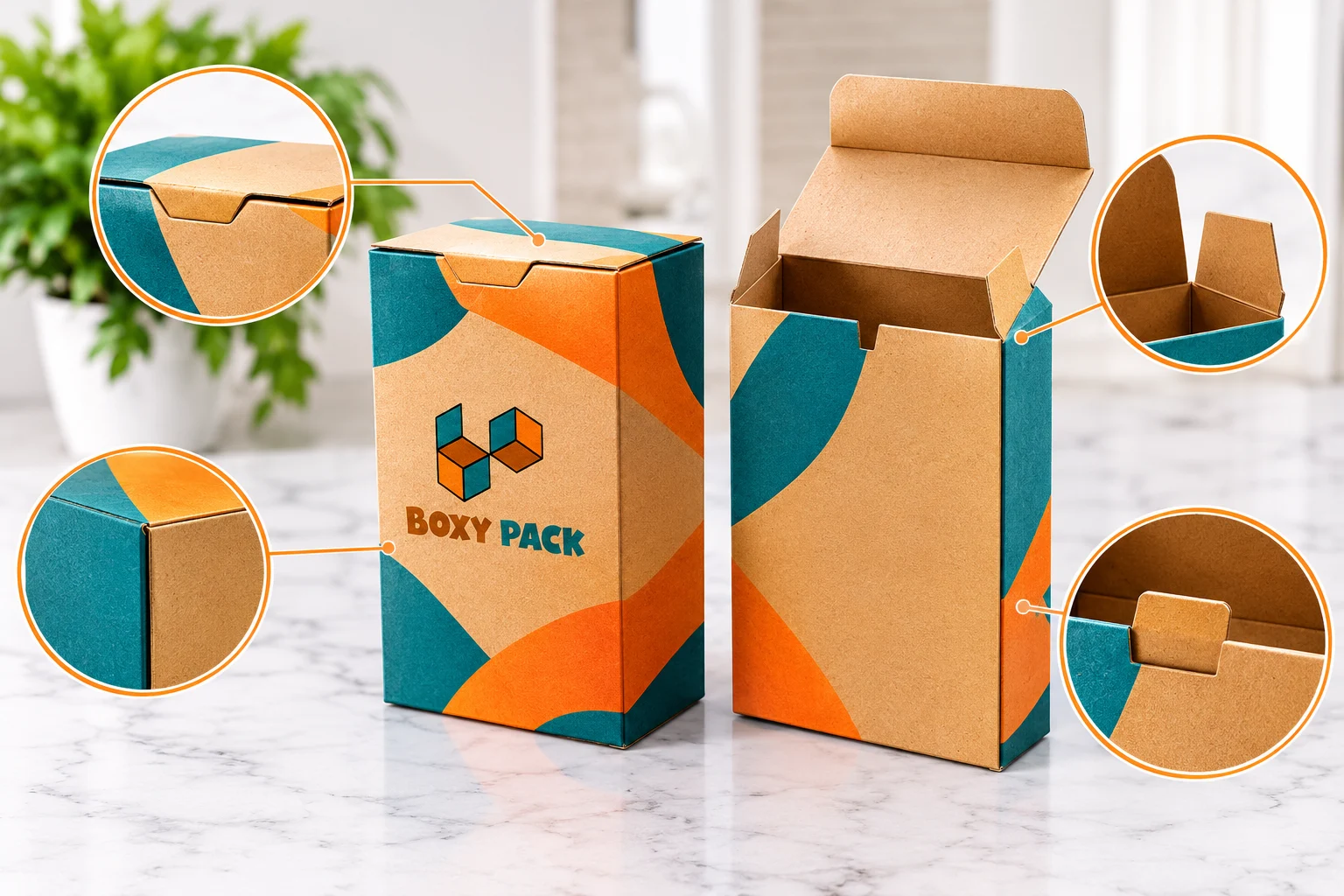
Front, back, and side panels form the carton body
The main panels fold around the product to create the carton walls. The front panel usually carries branding and product information, while the side panels give the carton its depth and structural support. Panel dimensions set the finished shape, so changing one panel changes the whole carton.
Tuck flaps fold over the openings
The main tuck flap folds inward to close the top or bottom opening. Dust flaps are the smaller side flaps that cover the gaps at each end so the product is not exposed. Flap length and shape affect how easily the carton opens and how securely it stays shut.
Glue tabs join the flat blank into a carton
The side seam, often called the manufacturer's joint, is bonded at the factory and turns the flat blank into a carton sleeve. It is separate from the tuck closure that consumers open and close. Many ordinary tuck cartons need no tape or glue when they are assembled for use.
Slots and tabs help keep the box closed
A tuck tab slips into the carton and stays put through friction, flap overlap, and sometimes slots or other locking features. This tuck box locking mechanism varies by design, so not every tuck box uses the same tab or slot.
How Straight Tuck End Boxes Differ From Reverse Tuck
The two most recognizable tuck box packaging types differ mainly in the direction their top and bottom flaps close. That direction affects the front panel, blank layout, assembly, and packing workflow. A straight tuck end box and a reverse tuck end box can hold the same product, so the choice usually comes down to presentation and production.
Feature | Straight tuck end (STE) | Reverse tuck end (RTE) |
Flap direction | Top and bottom flaps tuck in the same direction | Top and bottom flaps tuck in opposite directions |
Front appearance | Can leave a cleaner, uninterrupted front panel | Flap entry and closure arrangement differs by panel |
Typical use | Cosmetics, personal care, small retail goods | Pharmaceuticals, supplements, lightweight retail products |
Blank layout | May use more board depending on dimensions and layout | Often allows efficient nesting on a production sheet |
Selection priority | Front-panel presentation and display | Material efficiency and practical access |
Exact board use and cost depend on the dieline, sheet layout, dimensions, and supplier, not on tuck style alone.
Straight tuck ends keep both closures aligned
In straight tuck end packaging, the top and bottom flaps fold toward the same side of the carton. That can leave a clean display area on the front panel, which suits cosmetics, skincare, small electronics, and retail accessories. Beauty brands often pair this style with custom cosmetic boxes so the logo and product name get an unbroken front face.
Reverse tuck ends close from opposite directions
In reverse tuck end packaging, the top and bottom flaps tuck in opposite directions. This layout can be economical for many folding-carton designs, since blanks often nest efficiently on a sheet, and it works well for hand or machine packing. Common uses include medicines, supplements, and small consumer goods.
Match the tuck direction to product presentation
Consider which face will be displayed, how often the carton will be opened, how the product is loaded, and how it will be packed. Check the actual carton blank or a physical sample instead of choosing a structure from a product photo alone.
Other Tuck Box Styles for Different Product Needs
Straight and reverse tuck ends are not the only options. Some cartons pair a tuck top with a stronger or faster-assembling bottom, and some tuck-style boxes are built for heavier products or shipping. These retail product carton styles cover a wider range of needs.
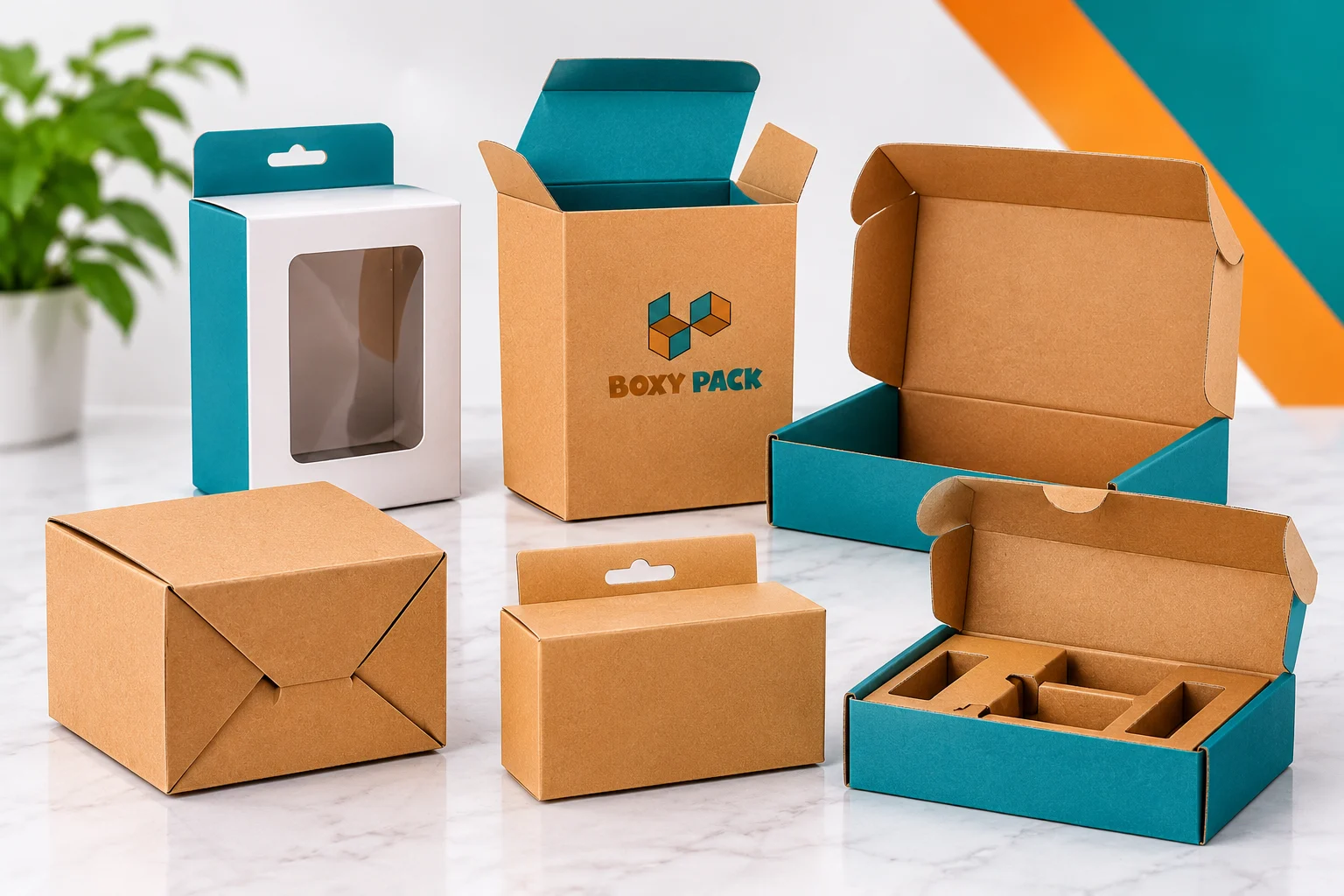
Tuck top auto-bottom boxes speed up packing
An auto-bottom carton has a pre-glued bottom that springs into position when the carton is erected. That cuts manual bottom-folding time in packing operations. It suits heavier retail products, bottles, and items that need a more supportive base.
Crash-lock and snap-lock bottoms add support
Interlocking bottom panels form a stronger base than a simple tuck bottom. When the carton is opened, the panels fold into place and hold together. The extra support helps with heavier products, though product weight and distribution still need testing.
Tuck-top mailers serve a different packaging role
Corrugated mailer boxes can use a tuck top on a larger, sturdier structure with stronger walls, which suits e-commerce and subscription deliveries. A shipping mailer is not interchangeable with a small retail tuck carton, because the two are built for different jobs.
Windows, hang tabs, and inserts add useful features
Die-cut windows show the product, hang tabs support peg displays, and inserts hold items in place. Each add-on changes the dieline, material use, production complexity, and protection. A large window, for example, removes board and can reduce stiffness.
In short, a standard tuck suits light products, an auto-bottom or lock bottom suits heavier ones, and a corrugated mailer suits shipping.
Choosing Paperboard for Strength, Weight, and Finish
The material must suit the product's weight, fragility, display, and storage conditions. Options range from smooth SBS paperboard to natural kraft boxes that show the fiber. Thickness, stiffness, surface finish, and printability all shape the finished carton. Paperboard carton packaging is also different from corrugated shipping material, which adds a fluted layer for cushioning.
Material | General characteristics | Suitable applications | Points to consider |
SBS paperboard | Smooth, white surface with good print presentation | Cosmetics, personal care, premium retail cartons | Cost and required board stiffness |
Coated recycled board | Recycled fiber with a coated printing surface | General retail cartons | Surface and strength can vary by grade |
Kraft paperboard | Natural brown appearance and visible fiber texture | Soap, candles, natural-product packaging | Printed colors may look different on brown stock |
Uncoated paperboard | More natural, absorbent surface | Simple printed cartons and understated designs | Ink appearance and scuff resistance |
Corrugated board | Fluted structure with added cushioning and rigidity | Shipping cartons and larger tuck mailers | Bulkier construction and different folding behavior |
Material names alone do not determine strength. Board grade, thickness, grain direction, carton dimensions, and design all matter.
Select board stiffness according to product weight
A small lightweight product needs less board strength than a glass container or dense item. Larger panels bend and crush more easily, so carton size affects the stock you need. Order a physical sample and run a fit test before committing to a large production run.
Consider coatings and finishes before choosing stock
Matte and gloss coatings, lamination, and soft-touch finishes change appearance, scuff resistance, folding behavior, and recyclability. Confirm that the finish works with the intended printing and converting process before you approve the stock.
How Tuck Box Dimensions Are Measured for a Product
Size the carton around the actual product rather than around its appearance. Tuck box dimensions are given as length, width, and depth, and the inside measurements are what decide fit.
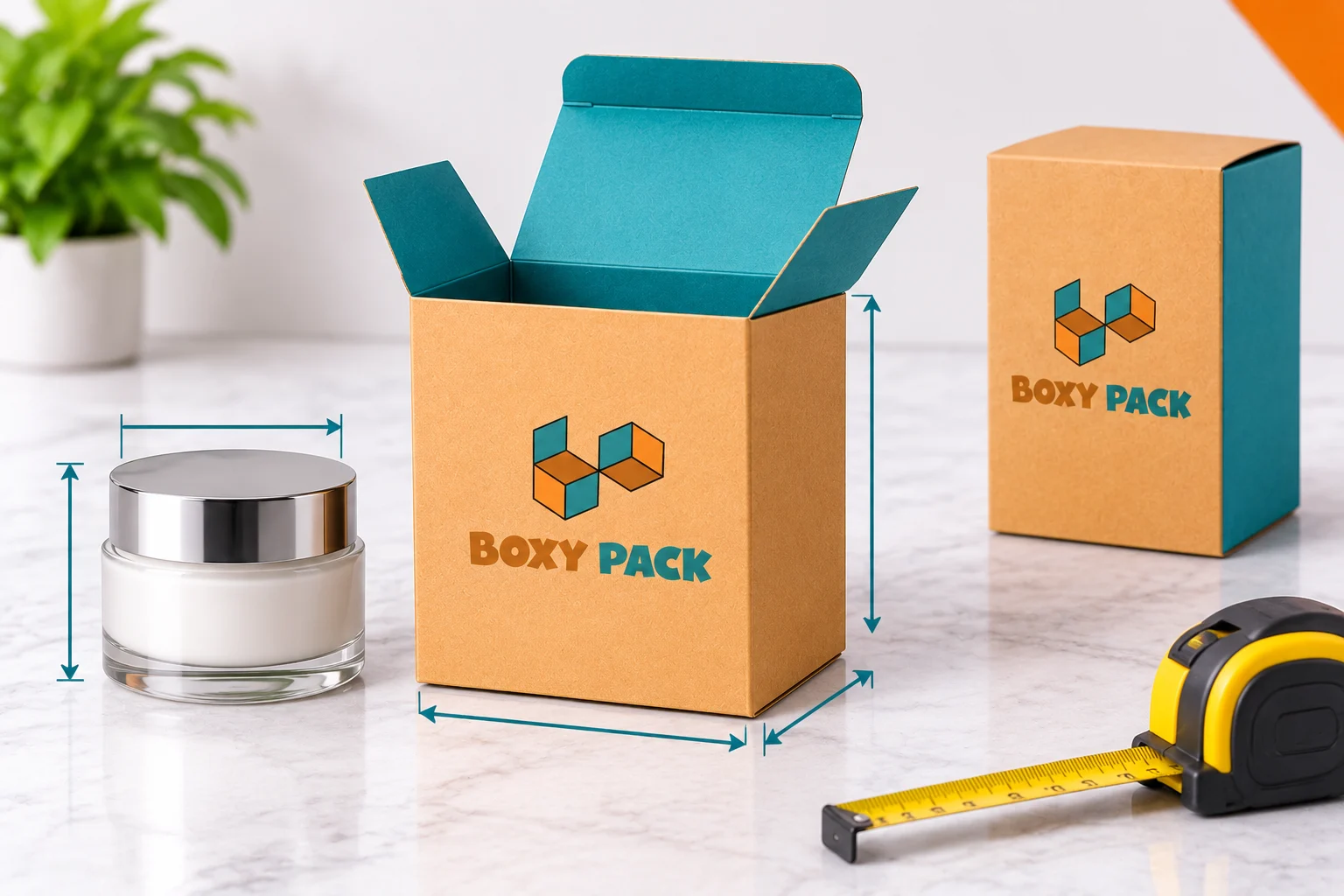
Measure the product at its widest points
Measure length, width, and height, including caps, protruding parts, and accessories. If units vary slightly, measure more than one and record the largest figure. Record measurements the same way every time to avoid mix-ups.
Add clearance without making the carton oversized
The product needs enough room to slide in and out easily. Inserts, trays, or protective wraps need extra internal space. A snug fit limits movement, while too much room lets the product rattle and can weaken the carton's look.
Confirm the internal and external box measurements
Board thickness and folded panels change the outside dimensions of the assembled box. Ask the supplier to state whether dimensions are inside or outside measurements. For example, a skincare jar that is 2.5 inches across and 3 inches tall might get about 1/8 inch of clearance per side and 1/4 inch at the top, giving internal dimensions of roughly 2.75 by 2.75 by 3.25 inches. The figures are illustrative; the supplier's dieline confirms the final size. A short checklist helps:
Measure the product at its widest and tallest points.
Add clearance and space for any insert.
Confirm whether the dimensions are inside or outside.
Check the result against the dieline before approving.
How the Tuck Box Dieline Shapes the Finished Carton
The dieline is the flat production layout that defines the panels, flaps, cuts, folds, and glue area. It connects visual design to the physical structure. Tuck box dieline design lays out the blank, while tuck box structural design decides how the carton performs once it is folded and filled.
Identify cut lines, crease lines, and glue areas
Cut lines separate the blank from the sheet, crease lines guide folds, perforations allow tearing, and glue zones mark where the seam is bonded. Keep artwork off critical glue areas and cut paths. Designers can keep technical marks on separate layers so they never print by accident.
Arrange panels and flaps around the product
In the flat layout, the front, back, side, top, and bottom panels connect so the carton folds correctly around the product. Tuck flaps, dust flaps, and locking tabs must sit where they can fold into place. The arrangement differs between straight tuck and reverse tuck cartons.
Check artwork placement before approving the dieline
Check safe margins, bleed, logo placement, barcode position, and readable product information. Review the carton in both flat and assembled views, and request a physical prototype or supplier sample before final production.
How Tuck Boxes Are Folded, Glued, and Assembled
A tuck box passes through the factory and then through simple assembly by a packer or customer. The tuck box folding process follows these steps.
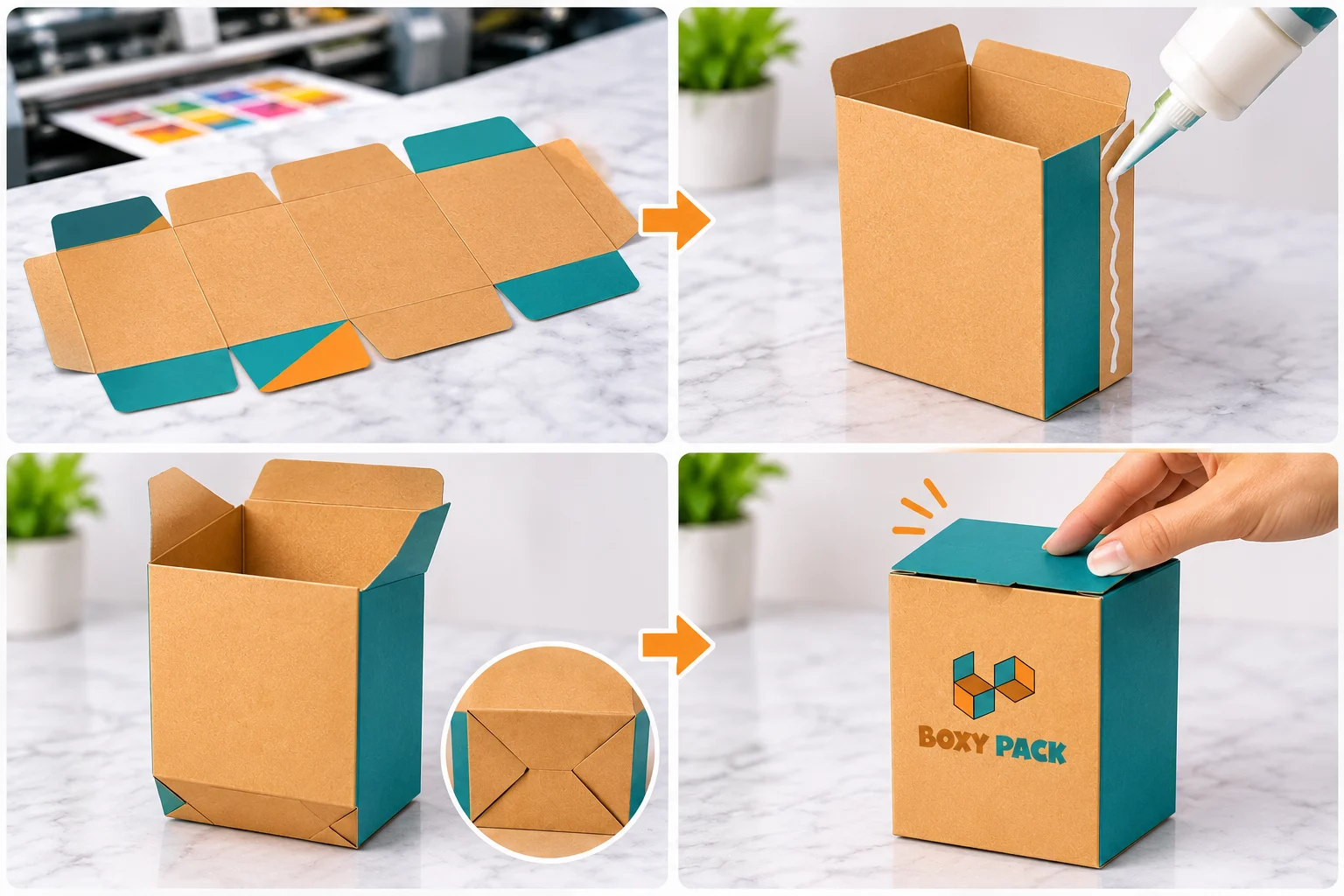
Step 1: Print and cut the flat carton blank
The board is printed, then cut and creased to the approved dieline. Accurate cutting and scoring help the carton fold cleanly. Production sequence can vary by converter and equipment.
Step 2: Fold and bond the manufacturer's joint
The blank is folded around and bonded at the side seam, creating a carton sleeve that ships flat. This glued joint is separate from the opening flaps.
Step 3: Erect the carton and close its bottom
Open the flat sleeve into its rectangular form, then secure the bottom using the tuck, snap-lock, or auto-bottom mechanism for that style. Check the bottom before loading the product.
Step 4: Insert the product and tuck the top flap
Place the product inside and fold the top flap into position. Check that the tuck tab is fully engaged without forcing or tearing the board. If the carton will be opened more than once, test repeated opening and closing.
Where Tuck Box Packaging Works Best Across Industries
Tuck cartons suit products whose size, weight, and protection needs match the board and closure strength. Common uses include:
Cosmetics and personal care: skincare products, soaps, small bottles, makeup, and accessories.
Pharmaceuticals and supplements: cartons for packaged products, where labeling and tamper-evidence needs must be handled separately.
Food and confectionery: dry snacks, chocolates, and bakery items, using food-contact materials and barriers where needed.
Electronics and accessories: cables, chargers, and small devices, often with inserts to prevent movement.
Games and collectibles: playing cards, small game components, and collectibles that need compact storage.
Promotional and gift packaging: samples, event giveaways, and small branded gifts.
What Makes Tuck Boxes Practical for Retail Packaging
Businesses choose tuck cartons for practical reasons. Flat blanks take up little storage space before assembly, the cartons are lightweight, and large printable panels leave room for branding and product information. Customers can open the closure without cutting tape, and different tuck and bottom styles allow different levels of support. Custom printing and finishes can add a distinctive retail look.
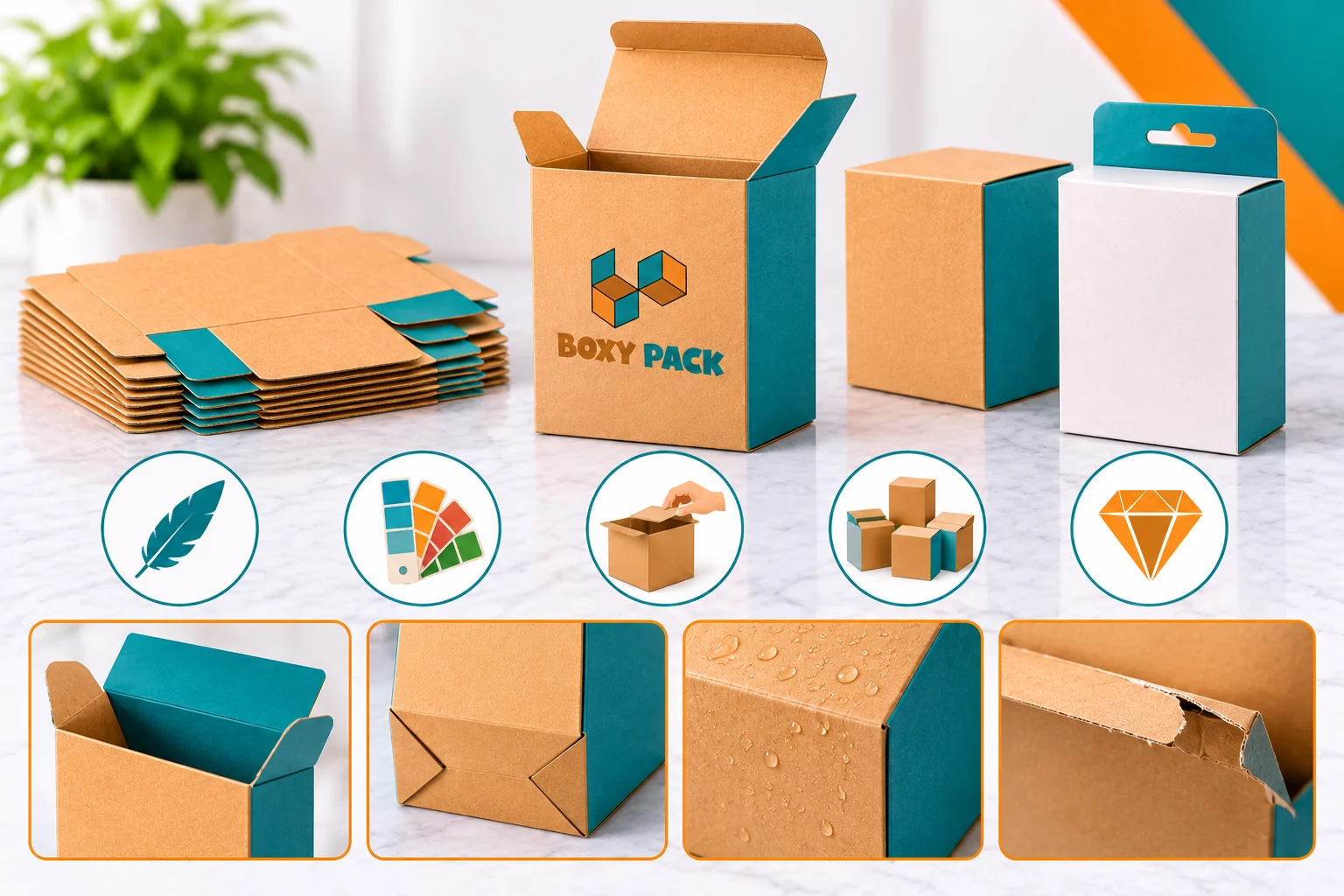
The limits matter too. A basic tuck closure may not provide a tamper-evident seal, and paperboard can lose strength when exposed to moisture. Heavy or fragile products may need reinforced bottoms, inserts, or a different box style. Repeated opening can also weaken tabs and creases over time.
Tuck Boxes Compared With Regular Cardboard Boxes
The phrase "regular cardboard box" can mean different constructions, so this comparison sets a standard paperboard tuck carton against a common corrugated shipping carton, such as the custom shipping boxes used to move goods through delivery networks. The tuck box vs regular cardboard box decision depends on protection, product weight, storage, assembly, and presentation.
Feature | Paperboard tuck box | Corrugated shipping box |
Main construction | Folding paperboard carton | Fluted corrugated board |
Typical use | Retail product packaging | Shipping and transport |
Storage before use | Usually ships as flat blanks | Usually ships flat |
Closure | Tuck flaps and optional locking base | Usually flaps closed with tape or another closure |
Product presentation | Strong printable retail surfaces | Primarily functional, though printable options exist |
Protection | Suitable for lightweight products when correctly specified | Often better suited to shipping and heavier handling |
Common add-ons | Windows, inserts, hang tabs, finishes | Inserts, dividers, cushioning, reinforced construction |
Some corrugated mailers also use tuck closures, so this is a comparison of common constructions, not an absolute rule. If the product sits on a shelf and needs to look good, a tuck carton is usually the better fit. If it must survive shipping and rough handling, corrugated is the safer starting point.
Design Details That Make Tuck Boxes Stand Out
Good tuck box design ideas improve appearance and usability without compromising the construction. Start with a clear front-panel hierarchy for the brand name, product name, and essential information, and pick colors and typography that stay readable at the actual carton size. A window helps when seeing the product supports the purchase decision, and foil stamping, embossing, debossing, or spot UV can highlight selected details.
Inside, a fitted insert keeps a product upright or separate from other components, and inside printing can carry instructions or brand messaging. Keep critical information away from folds, glue areas, and tuck slots, and test the finished design as an assembled carton before approving production. Decoration that makes the carton harder to fold or use works against the design.
How to Choose the Right Tuck Box for Your Product
Choosing a tuck box means weighing structure, material, and use together rather than picking by appearance or price. Work through these points:
Product size and internal clearance.
Product weight and bottom support.
Straight tuck versus reverse tuck closure.
Standard tuck bottom versus auto-bottom or lock-bottom.
Paperboard grade, thickness, and finish.
Need for inserts, windows, or hang tabs.
Manual versus automated packing.
Retail display versus e-commerce shipping.
Required printing, branding, and product information.
Sample testing before placing a full order.
For example, a small lip balm sold on a retail shelf could use a straight tuck end carton in SBS paperboard to keep the front panel clean. A 12-ounce bottle of liquid soap would likely need an auto-bottom or lock-bottom carton for added support. A subscription kit shipped by mail would suit a corrugated mailer instead.
Final Thoughts on Choosing the Right Tuck Box
A tuck box is a folding carton whose flaps tuck inward to close the openings. Straight tuck ends keep both closures on the same side for a clean front, reverse tuck ends close from opposite directions and often nest efficiently, and auto-bottom or lock-bottom variations add support for heavier products. Boxy Pack offers packaging solutions to help businesses choose suitable box styles for their product needs.
Whether a structure works depends on the material, dimensions, dieline, and product requirements. Before finalizing a specification, compare a physical sample or talk with a packaging supplier such as Boxy Pack, and test the fit with your actual product.
Frequently Asked Questions About Tuck Box Packaging
This section answers common questions about tuck box construction and material choices. It also covers assembly, environmental considerations, and product suitability. Use the answers as a starting point and confirm details with your packaging supplier.
Can a tuck box be made with a tamper-evident closure?
Yes, but a basic tuck closure is not tamper-evident on its own. Add a seal sticker, a perforated tab, or a similar feature, and confirm any regulatory requirements separately.
How much weight can a standard paperboard tuck box hold?
It depends on board grade, thickness, carton size, and design, so no single figure applies. Test a sample with the real product, and consider a stronger bottom for heavier items.
Can tuck boxes be printed on the inside as well as the outside?
Yes. Inside printing is commonly used for instructions or brand messaging, though it adds cost and should be specified at the artwork stage.
What is the difference between a tuck box and a folding carton?
Folding cartons are the broad category of cartons shipped flat and folded into shape. A tuck box is one style within it, closed by tucking flaps into the opening.
Do tuck boxes need a separate insert to protect fragile products?
Often, yes. A fitted insert limits movement and absorbs shock, and fragile products may also need a stronger board or a different box style.
Can tuck boxes be made from recycled or FSC-certified paperboard?
Yes, many suppliers offer recycled and FSC-certified paperboard. Ask for the specific grade and certification, since availability varies by supplier.
Ready to Get Started?
Discover our custom packaging solutions and bring your brand to life with premium boxes.