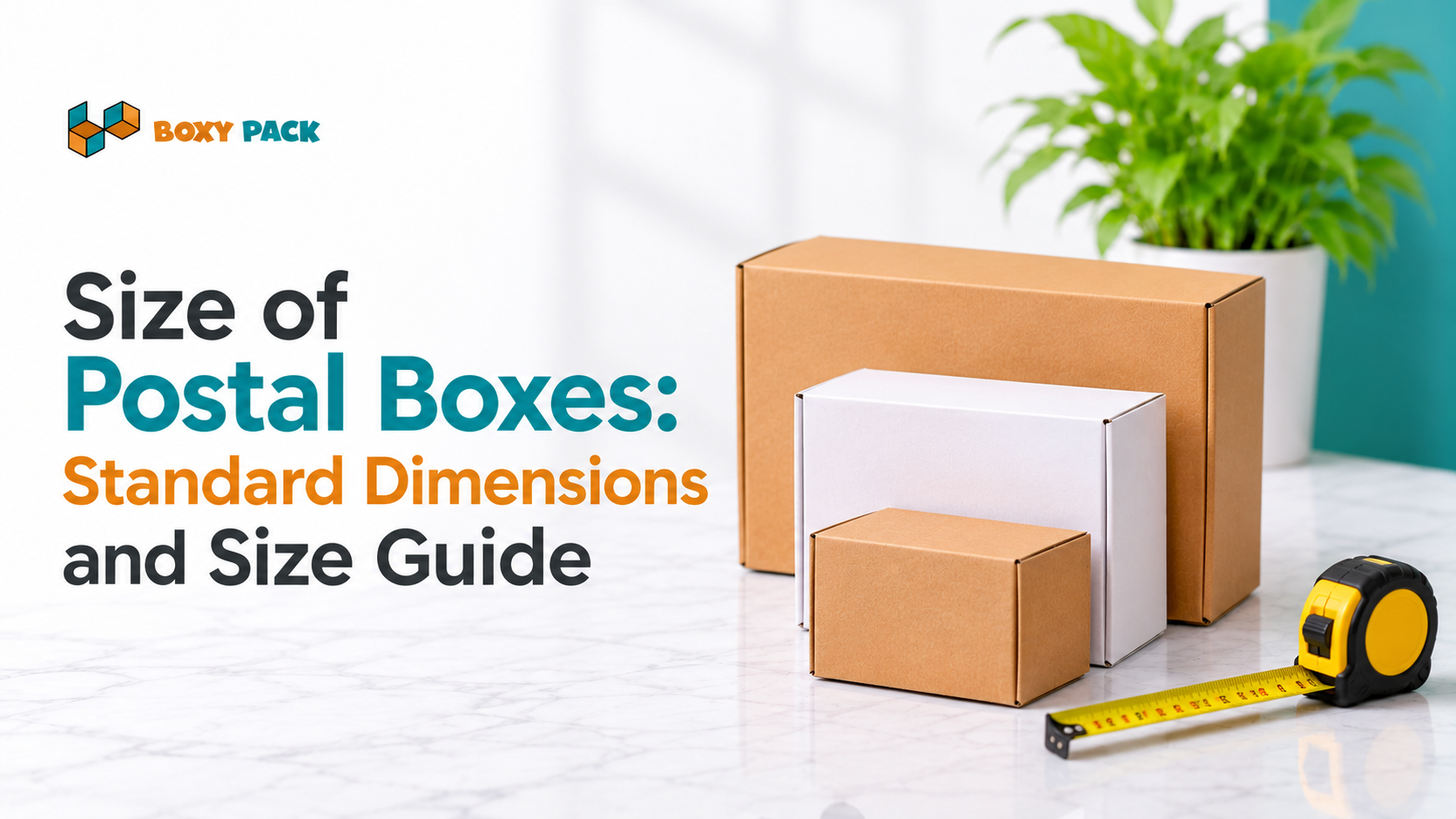
A box that is too small crushes the cushioning and stresses the product inside. A box that is too large lets the contents slide around and often pushes postage higher. Either way, the parcel arrives damaged or costs more than it should. Understanding the size of postal boxes before you pack is the simplest way to protect products, control shipping costs, and avoid trouble when a carrier checks your parcel.
USPS packaging is a useful reference for senders in the United States because its box dimensions are published and easy to compare. Standard box dimensions still vary between carriers, suppliers, and packaging products, so no single list covers every box on the market. This guide walks through the common small, medium, and large formats, shows how to measure a box correctly, and explains the size limits and dimensional weight rules that affect what you pay.
USPS Postal Box Sizes at a Glance for Everyday Shipping
If you are looking for standard postal box dimensions, USPS Flat Rate packaging is the clearest starting point. USPS offers small, medium, and large Flat Rate boxes alongside its standard Priority Mail packaging. Flat Rate boxes have fixed, identifiable measurements, while customer-supplied mailing boxes come in a wide range of sizes with no single mandated standard.
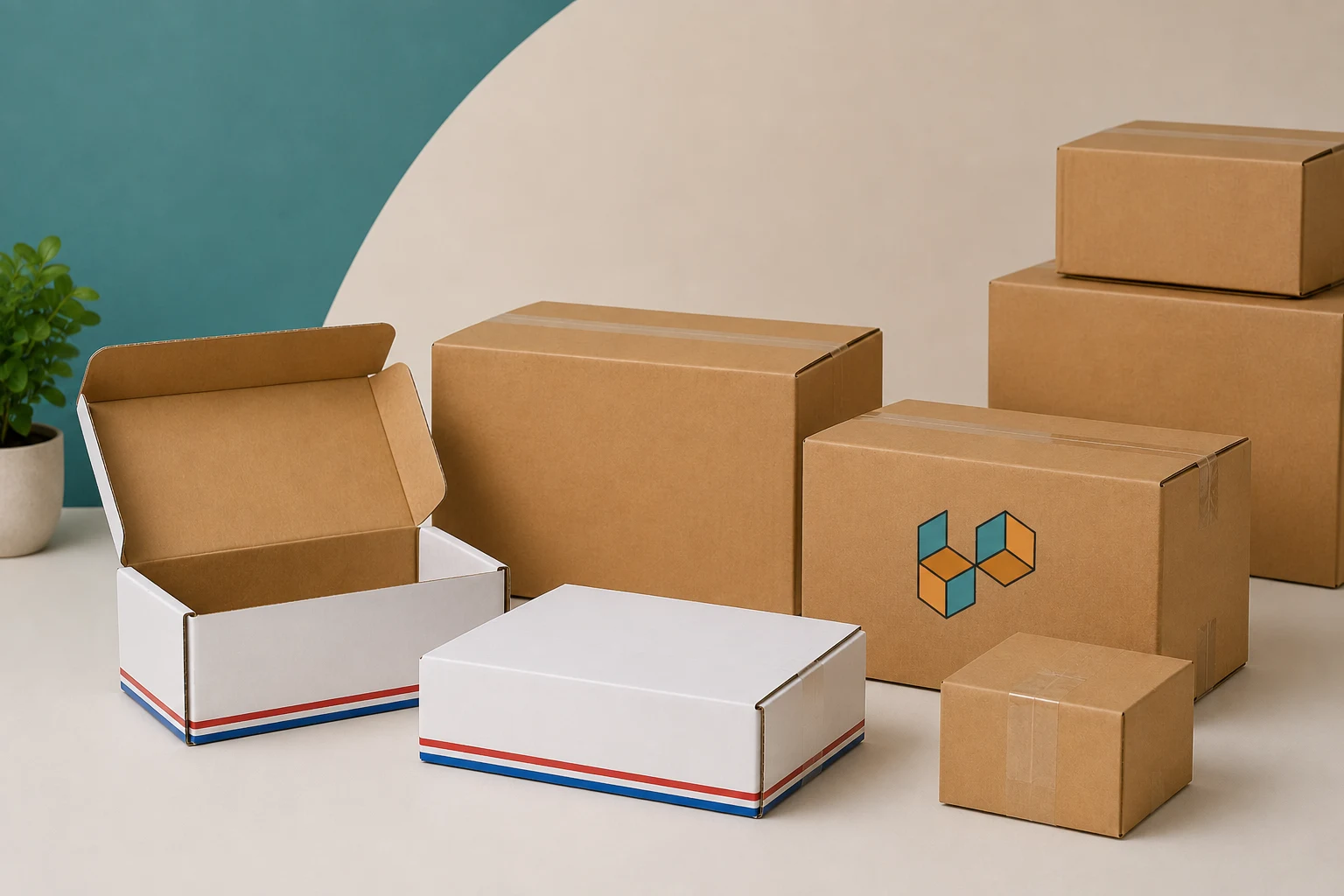
All dimensions in this article are written as length × width × height, in inches, and refer to external measurements.
Table: Common USPS Flat Rate Box Dimensions
USPS Box Type | External Dimensions (Inches) | General Shape |
Small Flat Rate | 8 11/16 × 5 7/16 × 1 3/4 | Compact and shallow |
Medium Top-Loading | 11 1/4 × 8 3/4 × 6 | Tall and rectangular |
Medium Side-Loading | 14 1/8 × 12 × 3 1/2 | Wide and shallow |
Large Flat Rate | 12 1/4 × 12 1/4 × 6 | Wide and spacious |
These are examples of USPS Flat Rate packaging, not a complete list of every USPS mailing box. Postage prices are left out on purpose, since this table is only about size. The two medium boxes show something worth remembering: "medium" describes a category, not one fixed shape.
Small Postal Boxes for Compact and Lightweight Parcels
Small postal boxes suit compact shipments such as accessories, small electronics, cosmetics, jewelry, and other lightweight products. Small postal box dimensions are usually measured in a few inches per side, and the smallest USPS Flat Rate option is shallow at under two inches deep. Small parcel box sizes work well for flat or slim items, but they leave little margin for error.
The number that matters most here is the internal usable space, not the label on the box. A product that measures 4 inches across can still fail to fit a box with a 4-inch interior once you add wrapping. Cushioning is where small boxes most often go wrong. Two layers of bubble wrap or a paper wrap can add an inch or more to each dimension, turning an apparently suitable box into one that is too small.
For retail products like rings and earrings, sellers often pair a shipping carton with presentation packaging such as small jewelry boxes, which sit inside the outer carton. In that case, measure the inner box, then add space for padding around it. The goal is the most compact box that still protects the product on every side.
Medium Postal Boxes for Everyday Shipping Needs
Medium boxes handle most regular parcel shipments, including clothing, books, household accessories, small appliances, and multiple retail products ordered together. Medium postal box dimensions and medium shipping carton sizes vary more than any other category, because the same overall volume can be arranged as a tall box or a wide, flat one. Table 1 shows this clearly: the top-loading and side-loading USPS mediums have very different shapes.
For that reason, match the box shape to the product rather than choosing by volume alone. Protective materials also reduce usable space, so a product that nearly fills the interior on paper will not accommodate padding in practice.

Medium Boxes for Stacked and Upright Products
Taller medium boxes work well for stacked books, bottles, and other upright products. The key measurement is vertical clearance. Measure the packaged product at its tallest, in the orientation it will travel, and leave room above and below for cushioning. Candle jars are a good example: they stand upright, are heavy for their size, and need padding on the bottom and top, which is why many sellers use dedicated candle shipping boxes sized around the jar's height.
As a simple check, if a stack of three books measures 5 inches high, a box with a 6-inch interior height leaves only half an inch of clearance in total. That is enough to close the box but not enough to cushion the stack, so a taller box would be the safer choice.
Medium Boxes for Flat and Wide Shipments
Wider, shallower boxes suit clothing, documents, framed items, and flat accessories. Spreading products horizontally avoids stacking pressure and lets you keep fragile items from resting on each other. To stop movement inside a wide box, fill gaps at the edges with folded paper or corrugated strips, and make sure the product cannot slide from side to side when you tilt the box.
Choosing Between Two Similar Medium Box Sizes
Small differences in length, width, and height can decide whether a product fits. Suppose you are shipping a folded blanket that measures 13 × 11 × 2 inches. A top-loading box with a 11 1/4 × 8 3/4 footprint will not take it, even though the box has plenty of volume. A side-loading box with a 14 1/8 × 12 footprint holds it flat with room to spare. Volume tells you how much a box holds in total, but only the individual dimensions tell you whether your specific item fits.
Large Postal Boxes for Bulky or Multiple Items
Large mailing boxes are made for bulky or multiple products, such as bedding, shoes, household goods, and large retail orders where several packaged items travel together. Large postal box dimensions typically start around 12 inches on a side, and large mailing box measurements can run to 18 inches or more in length, as the examples in the next section show.
Size has a cost. A large box can raise shipping charges even when the contents are light, because carriers price oversized or voluminous parcels differently. We cover that under dimensional weight below. Large boxes also need to be strong. A bigger box carries more load and is more likely to bow or collapse if the cardboard is too thin for the contents. Heavier or fragile items need sturdy corrugated board, and the interior must be supported so nothing shifts or compresses under the weight of other items.
Keep these points in mind when selecting a large box:
Choose a corrugated board rated for the weight of the contents, especially for heavy items.
Fill the extra volume with void fill or dividers, not empty air.
Check the combined length and girth against carrier limits before you pack.
Compare actual weight with dimensional weight before buying postage.
Do not default to a large box just because it is easier to fill.
Compare Standard Mailing Box Measurements Side by Side
Beyond USPS-branded packaging, most shippers use customer-supplied cardboard boxes. These common mailing box sizes are practical market examples rather than mandatory industry-wide standards. Sizes vary by supplier and by box construction, and many manufacturers offer custom dimensions. If you need a durable shipping format, corrugated mailer boxes are one of the common options, and they come in many sizes beyond those listed here.
Table: Illustrative Common Cardboard Mailing Box Sizes
Size Category | Example Dimensions (Inches) | Typical Applications |
Small | 6 × 4 × 2 | Accessories and compact products |
Small | 8 × 6 × 4 | Cosmetics and small retail goods |
Medium | 10 × 8 × 6 | Books and clothing |
Medium | 12 × 10 × 6 | Multiple retail products |
Large | 16 × 12 × 8 | Household goods |
Large | 18 × 14 × 12 | Bulky or multiple items |
These are illustrative box-size examples, not official USPS sizes. Use them as a postal box size guide rather than a fixed catalog. Reading down the table, you can see how each step up adds a few inches to every side, which multiplies volume quickly. A 6 × 4 × 2 box holds 48 cubic inches, while an 18 × 14 × 12 box holds 3,024. That jump is why choosing the right category matters for both protection and cost.
How to Measure Postal Boxes Correctly Before Shipping
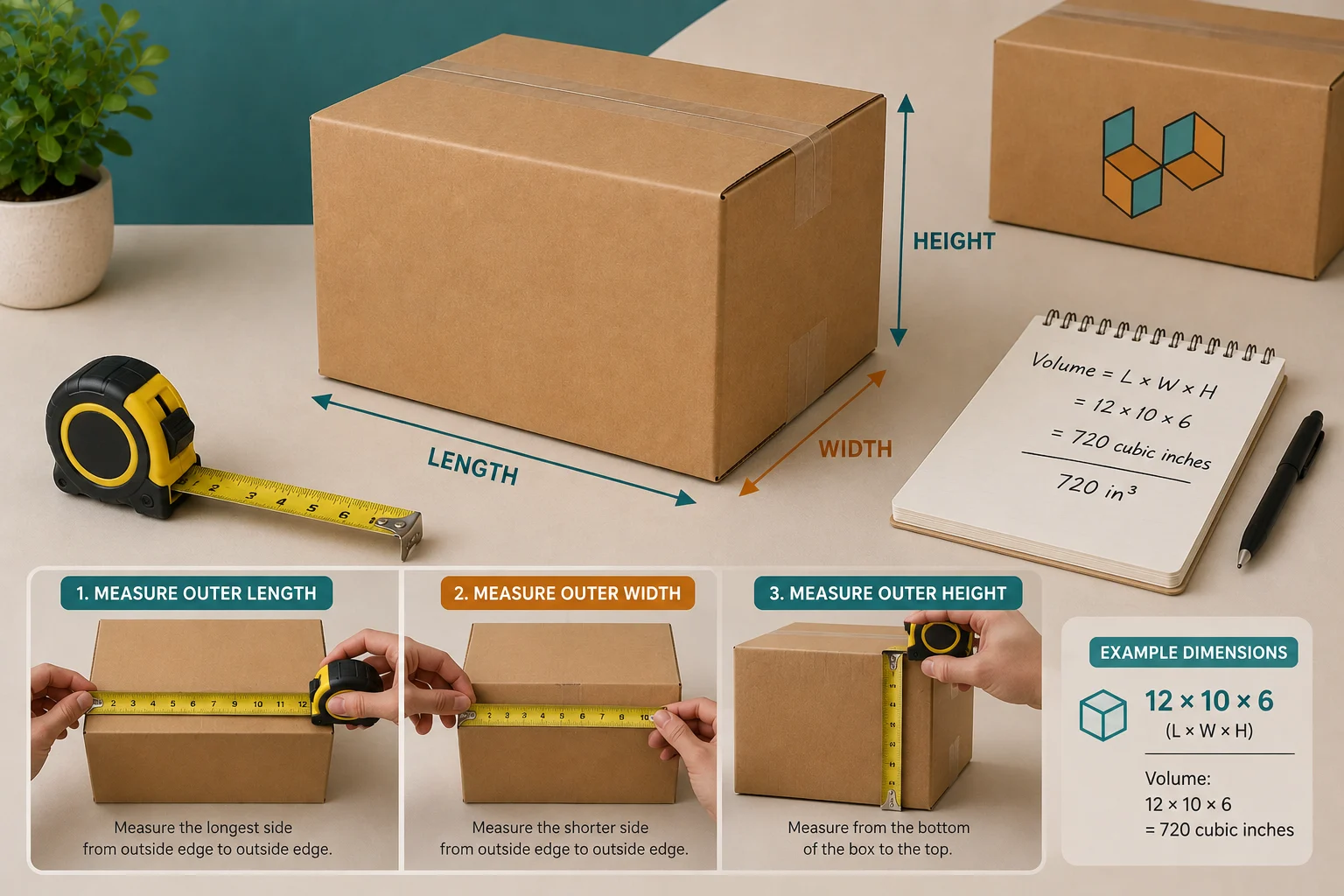
Knowing how to measure postal boxes accurately prevents most sizing mistakes. You only need a measuring tape or rigid ruler and a flat surface. Always measure the complete, assembled box rather than relying on the flat template or a dimension printed on a packaging listing, because folds and board thickness change the finished size. Accurate shipping box measurements also help you avoid postage adjustments after the carrier re-measures your parcel.
Identify the Correct Length, Width, and Height
Treat the longest side of the open top as the length and the shorter side as the width. Height is the vertical measurement when the box stands in its intended shipping position. For a rectangular mailing box that is 12 inches on its longest side, 10 inches across, and 6 inches tall, you would record 12 × 10 × 6. Always write measurements in the same order every time, so you can compare boxes and enter them correctly when buying a label.
Measure the Assembled Box From Its Outer Edges
Measure from the outside edges of the closed box. Corrugated cardboard has thickness, and folded flaps and tape add a little more. Carriers commonly use external package dimensions for parcel rating and size checks, so the outer measurement is the one that counts for postage. Measure after the box is properly closed, because a bulging lid or overstuffed carton can add a surprising amount to the height.
Calculate the Box's Total Cubic Volume
Volume equals length × width × height. A 12 × 10 × 6 box has a volume of 720 cubic inches. Volume helps you compare box shapes of different proportions, and it feeds into dimensional weight, which we cover shortly. But volume alone does not tell you whether a parcel meets carrier restrictions. Those depend on specific length, girth, and weight rules.
Internal and External Box Measurements Explained
The external dimensions determine the overall parcel size, which is what carriers measure. The internal dimensions indicate the usable space for your products. Because corrugated board has thickness, the interior is always smaller than the exterior, and the gap grows with thicker or double-wall construction.
This matters when you compare product measurements with box specifications. Imagine a product that is 8 inches long and a box listed as 8 × 6 × 4 on the outside. On paper it looks like a match, but with board thickness the interior length may be closer to 7 3/4 inches, so the product will not go in. Before ordering a quantity of boxes, check whether the listed measurements are internal or external, and test with a sample if you can. When a supplier does not say which one it lists, ask. Internal box measurements are the ones that decide fit.
How Much Empty Space Should You Leave Inside?
Every parcel needs a little extra room for protective packaging, but the right amount depends on the product. Too much empty space lets items move and collide during transport. Too little compresses cushioning and can damage the product. The target is a snug fit with protective material evenly placed on vulnerable sides. As a general rule, fragile and irregularly shaped products need more clearance than sturdy, flat ones.
Allow Room for Protective Packaging Materials
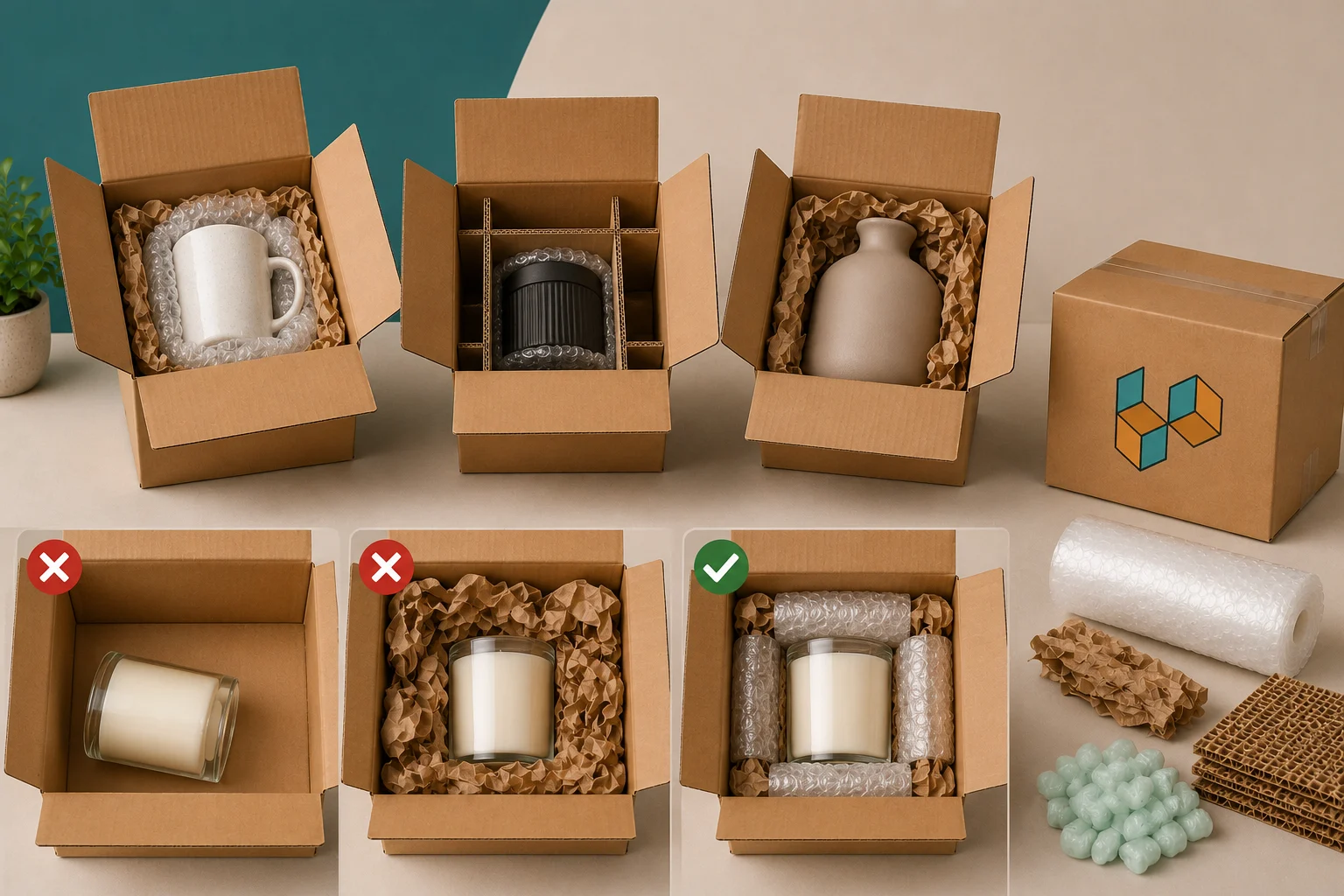
Bubble wrap, kraft paper, foam inserts, and corrugated cushioning each take up different amounts of space. Fragile products need padding on every vulnerable side, especially corners and edges. Dividers and thick corrugated inserts can separate multiple items and hold them in position without relying on loose fill. No universal fixed measurement works for all products, because the necessary clearance depends on both the item and the material you use.
Prevent Products From Moving Inside the Box
Void-fill materials such as crumpled paper, air pillows, or paper padding stabilize items and take up gaps. Without them, a product can shift and strike the walls of the box, which is a common cause of impact damage. A fragile glass item needs cushioning on all sides. An irregularly shaped product needs filler that follows its contours. When shipping several products in one box, wrap each one separately and make sure they cannot press against each other.
Avoid Choosing a Box That Is Too Tight
Do not force a product into an undersized box. Pressure on the corners, lid, and cushioning can crush the contents or burst a closure in transit. Test the fit before sealing: pack the item with its protective materials, close the flaps without forcing them, and give the box a gentle shake. If the lid bows or the contents shift noticeably, switch to a different size.
Choose Between Flat Rate and Standard Postal Boxes
USPS Flat Rate packaging and standard mailing boxes serve different needs. Flat Rate pricing requires the corresponding official USPS packaging, so you cannot use your own box and still get Flat Rate pricing. Priority Mail packaging is available free from USPS, but free packaging does not mean free postage. You still pay for the service. Regional Rate pricing has been discontinued and is no longer a current option.
When USPS Flat Rate Packaging Makes Sense
Flat Rate shipping has a fixed price for domestic parcels regardless of distance, which makes it attractive for heavy items traveling long distances. Predictable pricing helps sellers quote costs in advance. The condition is that you must use the correct official Flat Rate box and close it properly. The domestic maximum is 70 pounds, subject to service rules.
When Your Own Cardboard Mailing Box Is Better
A customer-supplied box offers more flexibility in dimensions. It works better for lightweight products, unusual shapes, and items that need customized inserts. Standard weight-and-zone shipping prices a parcel by its weight and how far it travels, which can be cheaper for light items. Brands that ship regularly often move to custom shipping boxes sized exactly to the product, which reduces void fill and unnecessary volume.
Understand Free and Prepaid Postal Packaging
Free carrier-supplied packaging is simply the box. Ordinary free Priority Mail packaging still requires the appropriate postage. USPS Forever Prepaid Flat Rate products are different, because they already include the postage. Prices change over time, so confirm current costs on the USPS website before you ship.
Domestic and International Parcel Size Limits
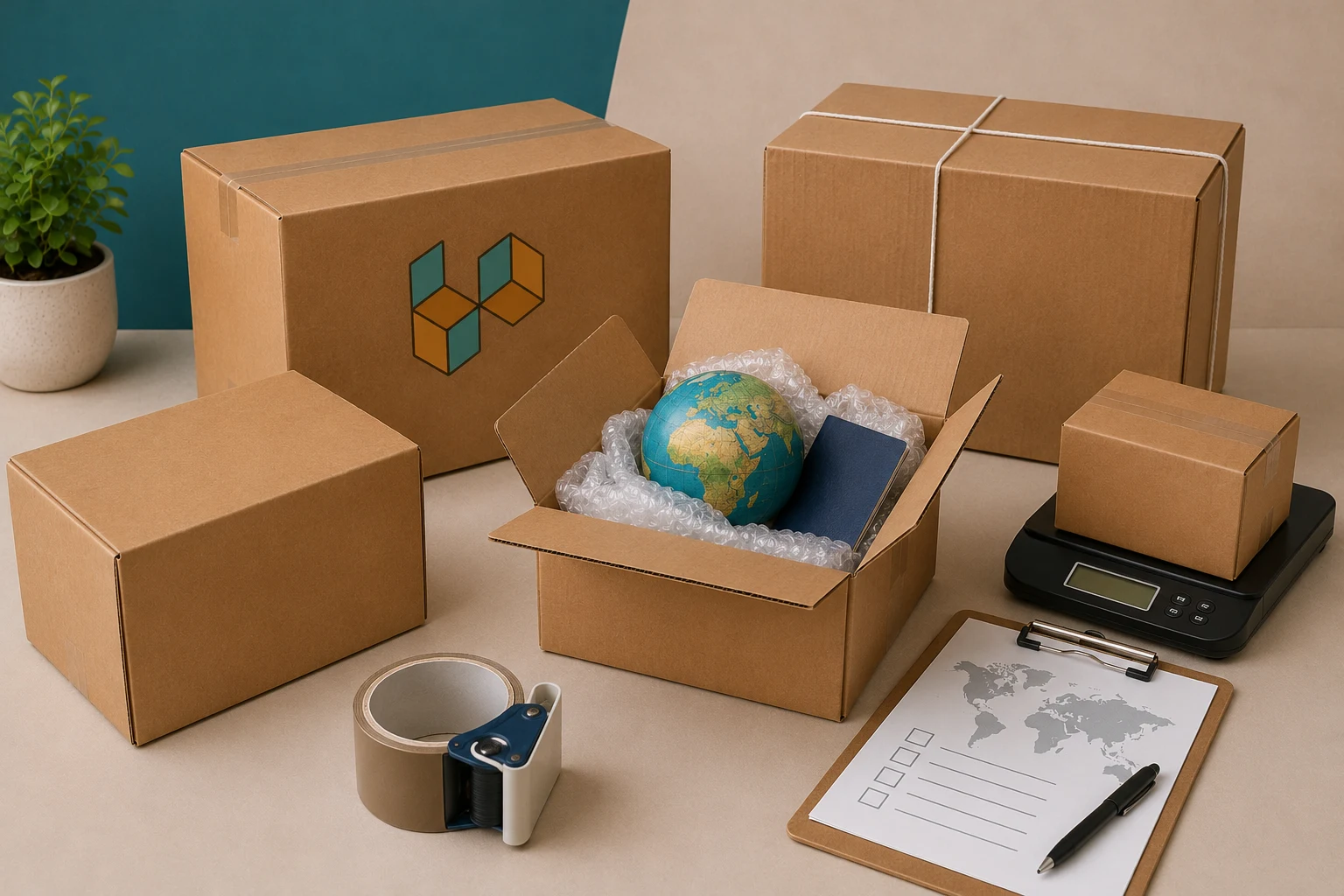
Postal size limits depend on the destination and the shipping service. Domestic postal packaging follows USPS rules for length, girth, and weight, while international shipping box dimensions depend on the destination country and the selected service. Always check maximum length, girth, weight, and any service-specific restrictions before packing.
Domestic USPS Parcel Size Restrictions
USPS generally limits domestic parcels to 108 inches in combined length and girth. USPS Ground Advantage is an exception that allows up to 130 inches combined, with applicable oversized pricing between 108 and 130 inches. The standard maximum weight is 70 pounds, although individual services may have lower limits. These are carrier restrictions, not recommended box dimensions.
International Shipping Box Dimensions and Limits
International limits are not identical for every destination. Size and weight limits depend on the country and the USPS service you choose, so check the USPS International Price Calculator and the individual country listings. Customs documentation and product restrictions add further requirements. A box accepted for domestic shipping may not qualify for an international service, which is another reason to check before you pack.
Check Parcel Restrictions Before Sealing the Box
Verify length, girth, total weight, and any destination-specific requirements before you buy a label. Checking the applicable service rules in advance can prevent repacking and unexpected shipping charges.
Table: Domestic Versus International Parcel Requirements
Measurement Factor | Domestic Shipping | International Shipping |
Maximum dimensions | Depends on service; USPS general length-plus-girth limit is 108 inches | Varies by destination and service |
Oversized parcels | Certain services allow up to 130 inches combined | Country and service-specific |
Weight limit | Generally up to 70 pounds, with exceptions | Varies by service and destination |
Customs documentation | Generally not required for ordinary domestic parcels | Required for applicable international merchandise shipments |
Final verification | USPS service standards | USPS country-specific listings |
How Dimensional Weight Changes Your Shipping Costs
Dimensional shipping weight explains why a large, lightweight parcel can cost more to ship than a smaller, heavier one. Carriers calculate package volume and convert it into a weight figure. USPS applies dimensional weight to eligible domestic parcels exceeding one cubic foot (1,728 cubic inches), and the higher of the actual and dimensional weights is used for pricing. Formulas and divisors vary by carrier, service, and applicable rules.
Understand the Basic Dimensional Weight Formula
The general calculation is length × width × height divided by the applicable carrier divisor. Check the divisor against the service you plan to use, because it differs between carriers and services. Measurements are generally rounded according to the carrier's rules. Dimensional weight is a billing figure, not what the parcel weighs on a scale.
Calculate Dimensional Weight With a Practical Example
Take a 20 × 16 × 12-inch package. Its volume is 3,840 cubic inches. Using a divisor of 139 for this illustration:
3,840 ÷ 139 = 27.63
The dimensional weight rounds up to 28 pounds. If the package actually weighs 10 pounds, the pricing weight would be 28 pounds wherever dimensional weight applies. Applicable USPS rules determine whether it is charged, so confirm the divisor and conditions for your chosen service.
Reduce Unnecessary Shipping Volume
Choose the smallest protective box that safely fits the product. Avoiding excessive void space reduces package volume, which can bring a parcel below the one-cubic-foot threshold or lower its dimensional weight. Before choosing a service, compare the actual weight and the dimensional weight so you know which one will drive the price.
Avoid Common Mistakes When Selecting Postal Boxes
Most box-sizing problems come from a short list of avoidable errors. These apply to individual senders and e-commerce businesses alike.
Choosing by external size alone. External size sets the parcel size, but fit depends on the interior.
Confusing internal and external measurements. Check which one a supplier lists.
Leaving excessive empty space. Loose contents move and get damaged.
Using an undersized box. Tight boxes compress cushioning and stress the product.
Assuming all medium boxes share one shape. Tall and wide mediums suit different products.
Ignoring the difference between Flat Rate and standard packaging. Flat Rate pricing needs official USPS boxes.
Forgetting length and girth limits. Large parcels can exceed carrier restrictions.
Using outdated carrier size information. Rules change, so verify current ones.
Ignoring dimensional weight on large boxes. Light parcels can still be priced as heavy.
Failing to measure the assembled, sealed package. Measure before buying postage.
Final Thoughts on Choosing the Right Postal Box Size
Choosing the right postal box comes down to matching the box to the product. Small, medium, and large boxes each serve different parcel requirements, and the shape of a box matters as much as its volume. Boxy Pack helps businesses find suitable packaging solutions for different shipping needs. USPS Flat Rate dimensions are specific packaging references, not universal industry standards, so treat them as helpful benchmarks and not rules that apply to every carton.
Always compare your product against internal measurements, leave enough protective space without leaving the contents loose, and check carrier size restrictions and dimensional weight before you buy postage. Doing this before you pack prevents repacking, damage, and unexpected charges.
When you are ready to choose packaging, compare suitable cardboard mailing box sizes against your product measurements, and verify the current carrier requirements for your service. Boxy Pack offers a wide range of box styles and custom sizes to help you find a fit that protects your products and keeps shipping costs in check.
Frequently Asked Questions About Postal Box Sizes
These are a few extra questions people often ask. They cover fit, carrier rules, and packing. Each answer is short and practical.
Can I use a regular cardboard box for USPS shipping?
Yes, in most cases. A sturdy, undamaged cardboard box can be used with standard services if it closes securely and meets size and weight limits. Flat Rate pricing is the exception, since it requires official USPS Flat Rate packaging.
Do postal box dimensions include the thickness of the cardboard?
External dimensions include the board thickness, while internal dimensions do not. Carriers generally measure the outside of the package, so use external figures for postage and internal figures for product fit.
What is the best box shape for shipping fragile products?
A box with some extra room on all sides works best, so you can place cushioning around every face of the product. Cube-like or slightly deeper boxes tend to protect items better than very long, shallow ones.
Can a package be rejected because its box is too large?
It can, if the parcel exceeds the size or weight limits for the service you selected. Oversized parcels may also be repriced or refused, so check length and girth limits before shipping.
Are USPS Flat Rate boxes available in different depths?
Yes. USPS offers formats such as the shallow small box, the 6-inch-deep top-loading medium, the 3 1/2-inch-deep side-loading medium, and the 6-inch-deep large box, as shown in Table 1.
Should I measure a box before or after adding protective materials?
Measure the product and protective materials together to choose the box, then measure the sealed, finished package to confirm its external dimensions for postage.
Do different shipping carriers use the same dimensional weight formula?
No. Divisors and thresholds vary by carrier and service, so apply the formula published by the carrier and service you plan to use.
Ready to Get Started?
Discover our custom packaging solutions and bring your brand to life with premium boxes.